



• Skip to main content
Press
  • Français
  • Institute
    • Mediterranean species
      Dusky grouper
      Snakelocks anemone
      White seabream
      Mauve stinger
      • About
      • › In brief
      • › Global advocacy
      • › 60+ years of history
      • › News
      • The Association
      • › Board of Directors
      • › Honorary Commitee
      • › Become a member
      • › Make a donation
      • A site in nature
      • › Mediterranean species
      • › Mediterranean biotopes
      • › Les Embiez island
      • The team
      • › Organisation
  • Research
    • Research programmes
      Environmental DNA (eDNA)
      Integrated multi-trophic aquaculture (IMTA)
      • › Research Programmes
      • › Research Center
      • › Scientific publications
      • › Scientific Communication
      • › International Cooperation
      • › Take OFF, Take Ocean For Future
  • Outreach
    • Environmental issues
      Nature-based solutions
      Biodiversity
      Governance
      • › General public and schoolchildren
      • › Popular science
      • › Newsletter
      • › Media library
      • › Press review
      • › Environmental issues
  • Blue economy
    • Interviews
      Dr Sylvain Couvray
      Dr Robert Bunet
      Olivier Dangles
      • › Le « carré magique » de la transformation
      • › Le Galpa Côte d'Azur
      • › Interviews Institute
  • Training
 › Abécédaire › Black seabream
Mediterranean species :

Black seabream

Swims in beautiful silvery schools
Did you know ?
Like quite a few other fish species, it is a protogynous hermaphrodite, meaning that it begins life as a female and becomes male later in life.

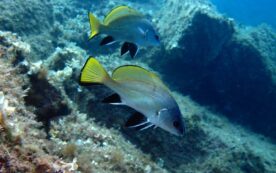
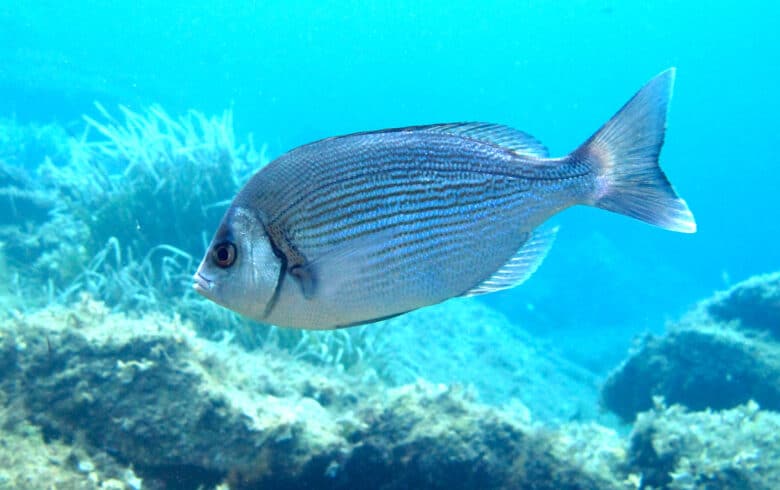
The black seabream is a beautiful silvery-grey fish tinged with blue, green and pink. It has broken longitudinal gold lines along its sides and its caudal fin has a black border. It has quite a high, flat body and a slight depression on its head above its eyes. This becomes a bump on the heads of old individuals, which can measure up to 60cm. The black seabream lives in schools. It is omnivorous and can feed on seaweed or small invertebrates, especially crustaceans. Rare in the Black Sea, it is found in the Mediterranean and from Scandinavia to Angola in the Atlantic. It lives on all types of sea bottoms at up to 200m deep.

Phylum: Vertebrates
Class: Osteichthyes
Order: Perciformes
Family: Sparidae
Scientific name: Spondyliosoma cantharus

French: Canthare
Spanish: Pargo chopra
Italian: Cantarella, Tanuta
German: Streifenbrasse Angenfleck

Black sea cucumber Prev
Black scorpionfish Next
Institut océanographique Paul Ricard
Île des Embiez - 83140 Six-Fours-les-Plages
Tél. +33 (0)4 94 06 36 26
  • › Partners
  • › Press
  • › Sitemap
  • › Terms & Conditions
  • › Privacy Policy
  • › Cookies Policy
  • › Credits