



• Skip to main content
Press
  • Français
  • Institute
    • Mediterranean species
      Dusky grouper
      Snakelocks anemone
      White seabream
      Mauve stinger
      • About
      • › In brief
      • › Global advocacy
      • › 60+ years of history
      • › News
      • The Association
      • › Board of Directors
      • › Honorary Commitee
      • › Become a member
      • › Make a donation
      • A site in nature
      • › Mediterranean species
      • › Mediterranean biotopes
      • › Les Embiez island
      • The team
      • › Organisation
  • Research
    • Research programmes
      Environmental DNA (eDNA)
      Integrated multi-trophic aquaculture (IMTA)
      • › Research Programmes
      • › Research Center
      • › Scientific publications
      • › Scientific Communication
      • › International Cooperation
      • › Take OFF, Take Ocean For Future
  • Outreach
    • Environmental issues
      Nature-based solutions
      Biodiversity
      Governance
      • › General public and schoolchildren
      • › Popular science
      • › Newsletter
      • › Media library
      • › Press review
      • › Environmental issues
  • Blue economy
    • Interviews
      Dr Sylvain Couvray
      Dr Robert Bunet
      Olivier Dangles
      • › Le « carré magique » de la transformation
      • › Le Galpa Côte d'Azur
      • › Interviews Institute
  • Training
 › Abécédaire › Spinous spider crab
Mediterranean species :

Spinous spider crab

Long legs and a broad carapace!
Did you know ?
They moult and you can often find small carapaces lying intact on the beach.

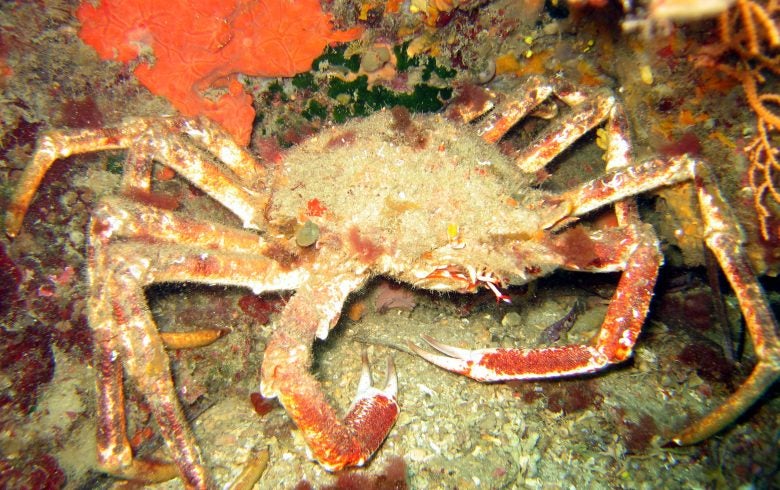
The spinous spider crab is protected by a beautiful, rounded red carapace that can measure up to 25cm long and 18cm wide. In large individuals, this carapace is a little wider than its length. In smaller ones, it is the opposite. It has distinctive wide spines around the edges that are alternately long and short. It also has a line of small spines across the midline of its back. Of its 6 legs, the front pair are smooth and wide with claws, while the others are slim and covered in tiny hairs. Its eyes can retract and are situated on either side of two sharp spears called a rostrum. This species is endemic to the Mediterranean and is found on all types of bottoms between the surface and about 50m deep. However, the young crabs stay close to the coast between the surface and 20m.

Phylum: Arthropoda
Class: Malacostraca
Order: Decapoda
Family: Malacostraca
Scientific name: Maja squinado

French: Grande araignée
Spanish: Centolla, araña de mar
Italian: Granceola

Spiny lobster Prev
Small-spotted catshark Next
Institut océanographique Paul Ricard
Île des Embiez - 83140 Six-Fours-les-Plages
Tél. +33 (0)4 94 06 36 26
  • › Partners
  • › Press
  • › Sitemap
  • › Terms & Conditions
  • › Privacy Policy
  • › Cookies Policy
  • › Credits