



• Skip to main content
Press
  • Français
  • Institute
    • Mediterranean species
      Dusky grouper
      Snakelocks anemone
      White seabream
      Mauve stinger
      • About
      • › In brief
      • › Global advocacy
      • › 60+ years of history
      • › News
      • The Association
      • › Board of Directors
      • › Honorary Commitee
      • › Become a member
      • › Make a donation
      • A site in nature
      • › Mediterranean species
      • › Mediterranean biotopes
      • › Les Embiez island
      • The team
      • › Organisation
  • Research
    • Research programmes
      Environmental DNA (eDNA)
      Integrated multi-trophic aquaculture (IMTA)
      • › Research Programmes
      • › Research Center
      • › Scientific publications
      • › Scientific Communication
      • › International Cooperation
      • › Take OFF, Take Ocean For Future
  • Outreach
    • Environmental issues
      Nature-based solutions
      Biodiversity
      Governance
      • › General public and schoolchildren
      • › Popular science
      • › Newsletter
      • › Media library
      • › Press review
      • › Environmental issues
  • Blue economy
    • Interviews
      Dr Sylvain Couvray
      Dr Robert Bunet
      Olivier Dangles
      • › Le « carré magique » de la transformation
      • › Le Galpa Côte d'Azur
      • › Interviews Institute
  • Training
 › Abécédaire › Fan mussel
Mediterranean species :

Fan mussel

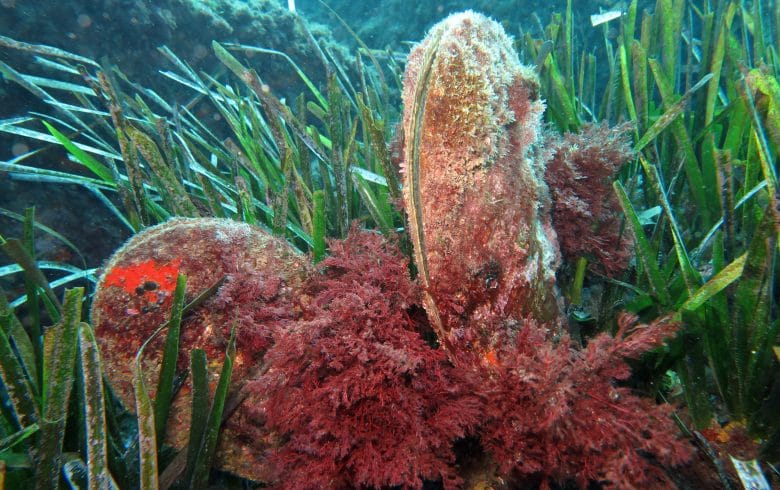
The largest shellfish in the Mediterranean!
Did you know ?
It attaches itself to the surface with its byssus, which was used in the past to weave a soft but sturdy cloth for gloves and scarves. The Golden Fleece in Greek mythology is said to have been made from a fan mussel’s byssus.

An adult fan mussel can measure up to 1m20. It looks like a giant mussel partly emerging from the sediment. The anterior part of younger individuals is covered in spiny scales that progressively disappear in adults. Like other bivalves, the fan mussel is a filter feeder that filters seawater through its gills to extract phytoplankton, but it also draws nourishment from organic deposits in the sediment. In France, it has been a protected species since 1992. It is found on loose substrates, phanerogam beds, rough sand and gravel from the surface to 60m deep. It is endemic to the Mediterranean.

Phylum: Mollusca
Class: Bivalvia
Order: Pterioida
Family: Pinnidae
Scientific name: Pinna nobilis

French: Grande nacre
Spanish: Nacra
Italian: Astura
German: Steckmuschel

False coral Prev
Dustbin-lid jellyfish Next
Institut océanographique Paul Ricard
Île des Embiez - 83140 Six-Fours-les-Plages
Tél. +33 (0)4 94 06 36 26
  • › Partners
  • › Press
  • › Sitemap
  • › Terms & Conditions
  • › Privacy Policy
  • › Cookies Policy
  • › Credits