



• Skip to main content
Press
  • Français
  • Institute
    • Mediterranean species
      Dusky grouper
      Snakelocks anemone
      White seabream
      Mauve stinger
      • About
      • › In brief
      • › Global advocacy
      • › 60+ years of history
      • › News
      • The Association
      • › Board of Directors
      • › Honorary Commitee
      • › Become a member
      • › Make a donation
      • A site in nature
      • › Mediterranean species
      • › Mediterranean biotopes
      • › Les Embiez island
      • The team
      • › Organisation
  • Research
    • Research programmes
      Environmental DNA (eDNA)
      Integrated multi-trophic aquaculture (IMTA)
      • › Research Programmes
      • › Research Center
      • › Scientific publications
      • › Scientific Communication
      • › International Cooperation
      • › Take OFF, Take Ocean For Future
  • Outreach
    • Environmental issues
      Nature-based solutions
      Biodiversity
      Governance
      • › General public and schoolchildren
      • › Popular science
      • › Newsletter
      • › Media library
      • › Press review
      • › Environmental issues
  • Blue economy
    • Interviews
      Dr Sylvain Couvray
      Dr Robert Bunet
      Olivier Dangles
      • › Le « carré magique » de la transformation
      • › Le Galpa Côte d'Azur
      • › Interviews Institute
  • Training
 › Abécédaire › Lobster
Mediterranean species :

Lobster

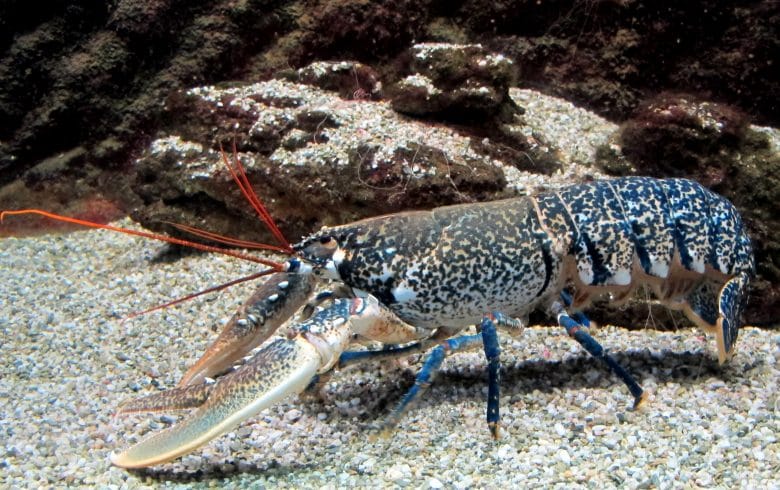
Its biggest claw is strong enough to crush shells!
Did you know ?
It is quite rare in the Mediterranean and as a nocturnal animal, quite hard to spot.
Lobsters eat food waste from conger eels, and the two species are often found together in cave mouths, except for juveniles, which are one of the eel's favourite prey!

This large crustacean can be recognised from its dark blue colour with beige spots, its red antennae and two giant claws. It uses the thinner one to cut pieces of fish flesh and the larger one to crush shells. They can be up to 60 cm long.
The lobster is a solitary animal that lives along rocky coastlines in cracks and crevices from 25 to 100m deep. They are found in the Mediterranean except in the Black Sea, and in the Atlantic from Morocco to Scandinavia.

Phylum: Arthropoda
Class: Crustacea
Order: Decapoda
Family: Nephropidae
Scientific name: Homarus gammarus

French: Homard
Spanish: Bogavante
Italian: Astice
German: Hummer

Longsnout wrasse Prev
Lesser slipper lobster Next
Institut océanographique Paul Ricard
Île des Embiez - 83140 Six-Fours-les-Plages
Tél. +33 (0)4 94 06 36 26
  • › Partners
  • › Press
  • › Sitemap
  • › Terms & Conditions
  • › Privacy Policy
  • › Cookies Policy
  • › Credits