



• Skip to main content
Press
  • Français
  • Institute
    • Mediterranean species
      Dusky grouper
      Snakelocks anemone
      White seabream
      Mauve stinger
      • About
      • › In brief
      • › Global advocacy
      • › 60+ years of history
      • › News
      • The Association
      • › Board of Directors
      • › Honorary Commitee
      • › Become a member
      • › Make a donation
      • A site in nature
      • › Mediterranean species
      • › Mediterranean biotopes
      • › Les Embiez island
      • The team
      • › Organisation
  • Research
    • Research programmes
      Environmental DNA (eDNA)
      Integrated multi-trophic aquaculture (IMTA)
      • › Research Programmes
      • › Research Center
      • › Scientific publications
      • › Scientific Communication
      • › International Cooperation
      • › Take OFF, Take Ocean For Future
  • Outreach
    • Environmental issues
      Nature-based solutions
      Biodiversity
      Governance
      • › General public and schoolchildren
      • › Popular science
      • › Newsletter
      • › Media library
      • › Press review
      • › Environmental issues
  • Blue economy
    • Interviews
      Dr Sylvain Couvray
      Dr Robert Bunet
      Olivier Dangles
      • › Le « carré magique » de la transformation
      • › Le Galpa Côte d'Azur
      • › Interviews Institute
  • Training
 › Abécédaire › Painted comber
Mediterranean species :

Painted comber

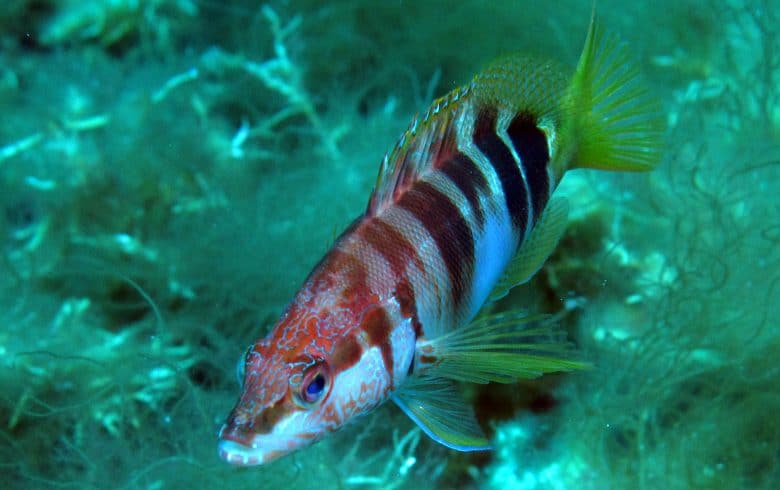
It looks as if its head has been painted.
Did you know ?
Like the brown comber, the painted comber is one of the few fish species that are both sexes at once. This is called simultaneous hermaphroditism.

This beautiful fish can be identified by its purplish-blue stomach and what look like fine, painted blue and red lines on its cheeks, hence its name. Its yellowish-red body has 5 to 7 dark brown vertical stripes. It is very solitary and actively defends a territory of a few square metres. It feeds on crustaceans and fish and can grow to 36 cm long. It lives in Posidonia seagrass meadows and on rocky bottoms down to 150m below the surface. It is found in the Mediterranean, the Black Sea and in the Atlantic from south of the British Isles to Senegal.

Phylum: Vertebrates
Class: Osteichthyes
Order: Perciformes
Family: Serranidae
Scientific name: Serranus scriba

French: Serran écriture
Spanish: Serrano
Italian: Sciarrano scrittura
German: Schriftbarsch

Pandora Prev
Ornate wrasse Next
Institut océanographique Paul Ricard
Île des Embiez - 83140 Six-Fours-les-Plages
Tél. +33 (0)4 94 06 36 26
  • › Partners
  • › Press
  • › Sitemap
  • › Terms & Conditions
  • › Privacy Policy
  • › Cookies Policy
  • › Credits