





• Skip to main content
Press
  • Français
  • Institute
    • Mediterranean species
      Dusky grouper
      Snakelocks anemone
      White seabream
      Mauve stinger
      • About
      • › In brief
      • › Global advocacy
      • › 60+ years of history
      • › News
      • The Association
      • › Board of Directors
      • › Honorary Commitee
      • › Become a member
      • › Make a donation
      • A site in nature
      • › Mediterranean species
      • › Mediterranean biotopes
      • › Les Embiez island
      • The team
      • › Organisation
  • Research
    • Research programmes
      Environmental DNA (eDNA)
      Integrated multi-trophic aquaculture (IMTA)
      • › Research Programmes
      • › Research Center
      • › Scientific publications
      • › Scientific Communication
      • › International Cooperation
      • › Take OFF, Take Ocean For Future
  • Outreach
    • Environmental issues
      Nature-based solutions
      Biodiversity
      Governance
      • › General public and schoolchildren
      • › Popular science
      • › Newsletter
      • › Media library
      • › Press review
      • › Environmental issues
  • Blue economy
    • Interviews
      Dr Sylvain Couvray
      Dr Robert Bunet
      Olivier Dangles
      • › Le « carré magique » de la transformation
      • › Le Galpa Côte d'Azur
      • › Interviews Institute
  • Training
 › Abécédaire › Cylinder anemone
Mediterranean species :

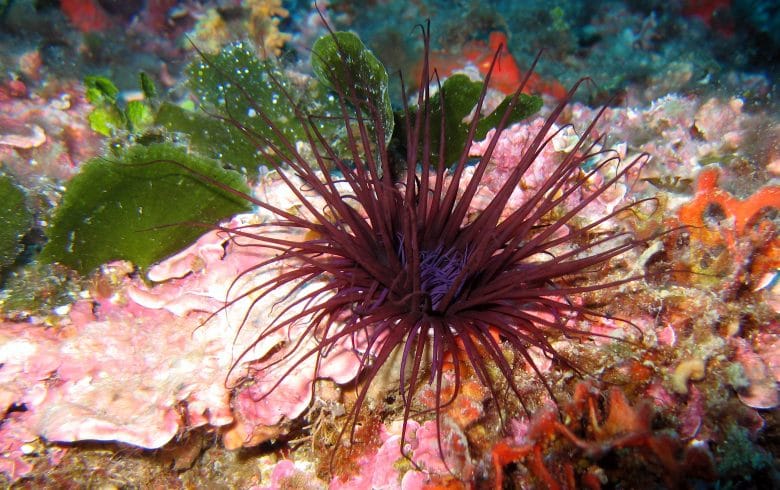
Cylinder anemone

At any sign of danger, it disappears inside its tube!
Did you know ?
They come in an array of colours, such as white, brown or beige but also purple or bright green.

The cylinder anemone grows a long tube burrowed deep into the sand and will disappear inside it if it senses danger. It measures 30 to 40cm in diameter with two whorls of tentacles of varying lengths. It is a hermaphrodite animal that captures small planktonic organisms by paralysing them. The species is endemic to the Mediterranean where it lives on sandy or muddy bottoms and among Posidonia rhizomes between the surface and 40m deep.

Phylum: Cnidaria
Class: Anthozoa
Order: Ceriantharia
Family: Cerianthidae
Scientific name: Cerianthus membranaceus

French: Cérianthe
Spanish: Cerianto
Italian: Fiore di mare
German: Zylinderrose

Deep-snouted pipefish Prev
Cuckoo wrasse Next
Institut océanographique Paul Ricard
Île des Embiez - 83140 Six-Fours-les-Plages
Tél. +33 (0)4 94 06 36 26
  • › Partners
  • › Press
  • › Sitemap
  • › Terms & Conditions
  • › Privacy Policy
  • › Cookies Policy
  • › Credits